


Social media has evolved from a brand awareness channel into a critical business growth engine. Yet many organizations still rely on intuition rather than evidence when making content and marketing decisions. In an increasingly competitive digital landscape, data analytics has become the difference between social media campaigns that generate meaningful results and those that simply create noise.
Businesses that leverage social media analytics can identify audience preferences, optimize content strategies, improve engagement rates, and maximize return on investment (ROI). Whether you’re a startup founder, marketing executive, or content creator, understanding how to transform raw social media data into actionable insights is essential for sustainable growth.
This guide explores how organizations can use data analytics to improve social media performance, increase audience engagement, and make smarter marketing decisions.

Why Data Analytics Matters in Social Media Marketing
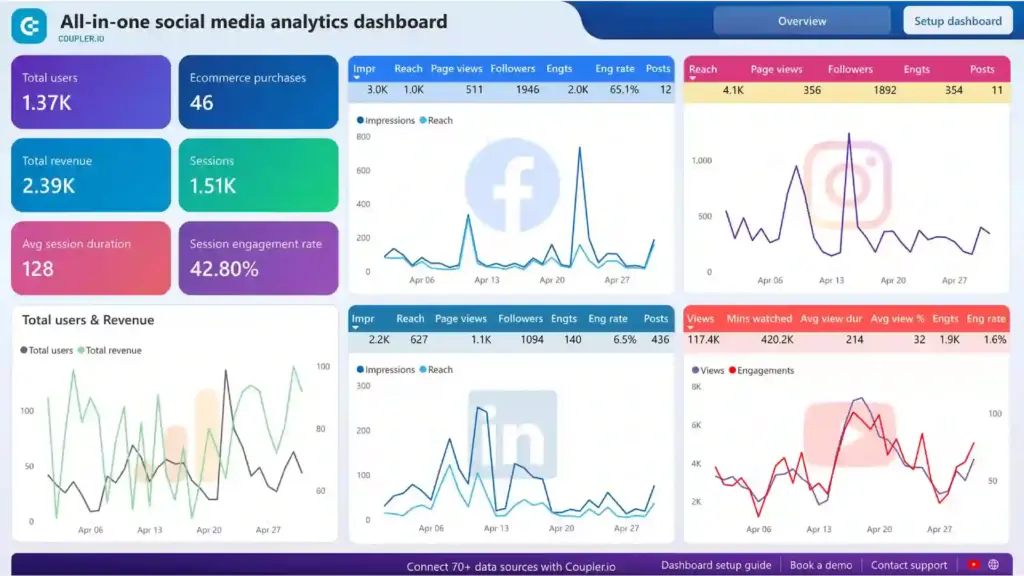
Social media platforms generate enormous amounts of data every second. Every like, comment, share, click, view, and conversion tells a story about audience behavior.
Data analytics helps marketers answer critical questions:
- Which content resonates most with audiences?
- What posting times generate maximum engagement?
- Which platforms deliver the highest ROI?
- How does audience behavior change over time?
- What factors influence conversions and sales?
According to research from Statista, social media users worldwide continue to grow annually, making competition for attention increasingly intense. Brands that use analytics effectively gain a significant advantage by understanding audience preferences before competitors do.
Rather than relying on assumptions, businesses can make decisions based on measurable evidence.
Define Clear Social Media KPIs
Before analyzing data, organizations must establish key performance indicators (KPIs) aligned with business objectives.
Different goals require different metrics.
Brand Awareness Metrics
If the objective is visibility, focus on:
- Reach
- Impressions
- Follower growth
- Video views
- Share rate
Engagement Metrics
For community building and audience interaction, track:
- Likes
- Comments
- Shares
- Saves
- Engagement rate
Conversion Metrics
For revenue generation, prioritize:
- Website clicks
- Lead generation
- Conversion rate
- Cost per acquisition (CPA)
- Revenue attributed to social campaigns
For example, a SaaS startup seeking customer acquisition should prioritize conversions rather than vanity metrics such as follower counts.
A clear KPI framework prevents teams from drowning in unnecessary data.

Understand Audience Behavior Through Analytics
One of the most valuable applications of social media analytics is audience intelligence.
Modern platforms provide detailed insights about:
- Age demographics
- Gender distribution
- Geographic locations
- Device usage
- Active hours
- Content preferences
These insights help marketers create highly relevant content.
Consider a fitness brand discovering that most of its audience consists of working professionals aged 25-40 who engage primarily during evenings. This insight could lead to scheduling content between 6 PM and 9 PM rather than posting throughout the day.
Audience analytics also reveal emerging trends and changing interests, allowing brands to adapt quickly.
Key Audience Questions to Explore
- Who engages with content most frequently?
- Which customer segments convert best?
- What topics generate discussions?
- What content formats perform best for different audience groups?
The deeper the understanding of audience behavior, the more effective content strategies become.
Analyze Content Performance to Identify Winners
Not all content performs equally.
Data analytics helps identify which content types consistently drive results.
Common content categories include:
- Educational posts
- Industry insights
- User-generated content
- Behind-the-scenes content
- Product demonstrations
- Short-form videos
- Live streams
By comparing engagement and conversion metrics across categories, marketers can identify.
Use A/B Testing to Optimize Performance
A/B testing is one of the most powerful analytical techniques in social media marketing.
Instead of guessing what works, marketers can test variables such as:
- Headlines
- Images
- Video thumbnails
- Captions
- Call-to-action (CTA) phrases
- Posting times
- Hashtags
For instance, a company may test:
Version A: “Download our free guide.”
Version B: “Get your free growth guide today.”
If Version B produces significantly higher click-through rates, future campaigns can incorporate similar messaging.
Continuous testing creates incremental improvements that compound over time.
Organizations that embrace experimentation often outperform competitors relying solely on creative instinct.

Measure Social Media ROI Effectively
One of the biggest challenges in social media marketing is proving business value.
Analytics platforms help connect social activity to actual outcomes.
Key ROI metrics include:
- Revenue generated
- Lead quality
- Customer acquisition cost
- Conversion rates
- Customer lifetime value
Tools such as Google Analytics allow marketers to track website traffic and conversions originating from social media channels.
For example:
- Campaign Cost: $5,000
- Revenue Generated: $20,000
ROI Formula:
ROI=CostRevenue−Cost×100
Result:
ROI = 300%
This level of visibility enables leadership teams to allocate marketing budgets more confidently.
Leverage Predictive Analytics for Strategic Growth
Traditional analytics explains what happened.
Predictive analytics helps forecast what may happen next.
Using historical performance data, organizations can anticipate:
- Future engagement trends
- Seasonal demand fluctuations
- Optimal posting schedules
- Content performance probabilities
- Customer behavior patterns
For example, retailers often identify recurring engagement spikes before major shopping events and adjust content calendars accordingly.
Large enterprises increasingly use artificial intelligence and machine learning tools to enhance predictive capabilities. However, even small businesses can gain valuable forecasting insights through historical trend analysis.
Predictive analytics transforms social media from a reactive function into a proactive growth strategy.
Monitor Competitors and Industry Benchmarks
Analytics should not focus solely on internal performance.
Competitive intelligence provides valuable context.
Businesses should evaluate:
- Competitor engagement rates
- Content frequency
- Audience growth
- Popular content themes
- Platform performance
Tools such as Sprout Social, Hootsuite, and Buffer offer benchmarking capabilities that help organizations understand their position within the market.
For example, a brand achieving a 4% engagement rate may initially appear successful. However, if industry competitors average 8%, there is significant room for improvement.
Benchmarking transforms isolated metrics into meaningful business intelligence.
Build Data-Driven Content Strategies
The ultimate goal of analytics is action.
High-performing organizations establish feedback loops where insights continuously improve strategy.
A practical framework includes:
Step 1: Collect Data
Gather metrics from:
- Social platforms
- Website analytics
- CRM systems
- Advertising platforms
Step 2: Identify Patterns
Look for recurring performance trends.
Step 3: Generate Insights
Ask why specific content succeeded or failed.
Step 4: Implement Changes
Adjust:
- Content themes
- Publishing schedules
- Creative formats
- Audience targeting
Step 5: Measure Results
Evaluate whether strategic adjustments improved performance.
This cycle creates continuous optimization and long-term growth.
Common Analytics Mistakes to Avoid
Even sophisticated marketers can misuse data.
Avoid these common pitfalls:
Focusing on Vanity Metrics
High follower counts do not necessarily indicate business success.
Ignoring Context
A temporary engagement spike may result from external events rather than content quality.
Measuring Too Many Metrics
Concentrate on KPIs directly linked to business goals.
Failing to Act on Insights
Data without execution provides no value.
Overlooking Long-Term Trends
Weekly fluctuations are less important than sustained performance improvements.
Organizations that avoid these mistakes extract greater value from their analytics efforts.
The Future of Social Media Analytics
The future of social media analytics lies in AI-powered insights, predictive modeling, sentiment analysis, and real-time decision-making.
As platforms generate increasingly sophisticated data, marketers will move beyond simple reporting toward automated optimization and strategic forecasting.
Businesses that invest in analytics capabilities today will be better positioned to understand customer behavior, personalize experiences, and maximize marketing efficiency tomorrow.
The most successful brands will not necessarily be those with the largest budgets, but those that make the smartest decisions based on data.
Conclusion
Data analytics has become an essential component of effective social media marketing. By defining clear KPIs, understanding audience behavior, analyzing content performance, conducting A/B tests, measuring ROI, and leveraging predictive insights, organizations can transform social media from a communication channel into a measurable growth driver.
The key is not collecting more data, but extracting meaningful insights and acting on them consistently. Businesses that embrace a data-driven culture gain a powerful competitive advantage, enabling them to engage audiences more effectively, allocate resources intelligently, and achieve stronger business outcomes.
As social media continues to evolve, analytics will remain the foundation of informed decision-making and sustainable digital growth.
FAQ
1. What is social media analytics?
Social media analytics is the process of collecting, measuring, and analyzing data from social platforms to evaluate performance and improve marketing outcomes.
2. Which social media metrics are most important?
The most important metrics depend on business goals but often include engagement rate, reach, click-through rate, conversions, and ROI.
3. How often should businesses review social media analytics?
Most organizations should review key metrics weekly, conduct monthly performance evaluations, and perform quarterly strategic assessments.
4. Can small businesses benefit from social media analytics?
Yes. Even basic analytics can help small businesses understand customer preferences, optimize content, and improve marketing efficiency.
5. What tools are best for social media analytics?
Popular tools include Google Analytics, Sprout Social, Hootsuite, and native analytics provided by social media platforms.