


Every click, scroll, and page load on the internet consumes energy. While the web feels invisible, it runs on physical infrastructure: data centers, networks, and devices that collectively contribute to global carbon emissions. Recent studies estimate that the internet is responsible for roughly 3 to 4 percent of global CO2 emissions, comparable to the aviation industry. As digital adoption accelerates, this footprint continues to grow.
Sustainable web design addresses this challenge by rethinking how websites are built, hosted, and experienced. It focuses on reducing the carbon cost of pages without sacrificing performance or aesthetics. For businesses, this is not just an environmental issue. Faster, lighter websites improve user experience, reduce bounce rates, and align brands with rising expectations around environmental responsibility. Sustainable web design is where climate awareness meets smart digital strategy.
Understanding the Carbon Cost of Web Pages
The carbon cost of a web page refers to the greenhouse gas emissions generated when that page is loaded and used. This includes energy consumed by data centers processing requests, networks transmitting data, and user devices rendering content. Each kilobyte matters because larger pages require more data transfer and computation.
According to measurements from tools like Website Carbon Calculator, the average web page today emits around 0.8 grams of CO2 per page view. At scale, this adds up quickly. A site with 100,000 monthly visits could generate nearly one metric ton of CO2 per year, equivalent to hundreds of kilometers driven by a car.
A major driver of this increase is page bloat. Over the last decade, average page size has more than tripled due to heavy images, videos, scripts, and tracking technologies. While these elements can enhance engagement, many are unnecessary or poorly optimized. Sustainable web design starts with awareness: understanding that every design decision has an environmental cost.
Why Sustainable Web Design Matters for Business
Sustainable web design is often framed as an ethical choice, but it is also a commercial one. Leaner websites load faster, rank better in search engines, and convert more effectively. Search engines such as Google explicitly reward speed and performance, which align closely with low-carbon design principles.
From a brand perspective, sustainability has become a trust signal. Consumers increasingly expect companies to act responsibly, and digital operations are part of that equation. A visibly sustainable website supports ESG goals and strengthens credibility with investors, partners, and customers.
There is also a cost argument. Efficient websites reduce bandwidth usage and server load, lowering hosting and infrastructure expenses over time. In regions where energy costs are rising, digital efficiency directly impacts the bottom line. Sustainable web design proves that environmental responsibility and business performance can reinforce each other.
Core Principles of Sustainable Web Design
Sustainable web design is not about stripping sites down to bare text. It is about intentionality. The first principle is efficiency: delivering the same or better user value with fewer resources. This involves optimizing assets, minimizing code, and avoiding unnecessary features.
The second principle is longevity. Websites should be designed to age well, avoiding trends that require frequent redesigns and rebuilds. A long-lasting site reduces the emissions associated with repeated development cycles.
The third principle is accessibility and inclusivity. Simple, clear designs not only reduce data usage but also work better on older devices and slower connections. This aligns sustainability with digital equity, especially in emerging markets where bandwidth and energy are constrained.
Design Choices That Reduce Carbon Emissions
Visual design plays a surprisingly large role in a website’s carbon footprint. Image-heavy layouts, autoplay videos, and complex animations significantly increase page weight. Compressing images, using modern formats like WebP, and loading media only when needed can cut emissions dramatically.
Typography choices matter as well. Custom fonts require additional downloads, while system fonts rely on assets already present on user devices. Color schemes can also influence energy use, particularly on OLED screens where darker pixels consume less power.
Another key factor is interaction design. Infinite scroll, aggressive tracking, and frequent background requests generate continuous data transfer. Thoughtful limits on these features reduce energy consumption while often improving user focus and satisfaction.
Development and Technical Optimization
Beyond design, development practices determine how efficiently a site runs. Clean, well-structured code reduces processing requirements. Eliminating unused JavaScript and CSS can significantly shrink page size and execution time.
Caching and content delivery networks help by serving content closer to users, reducing the distance data travels. Static site generation is another powerful approach, as static pages require far less server-side computation than dynamic ones.
Framework choice also matters. While modern frameworks enable rich experiences, they can introduce heavy overhead if not used carefully. Sustainable web design encourages developers to question whether complexity is truly necessary for the user’s goal.
The Role of Green Web Hosting
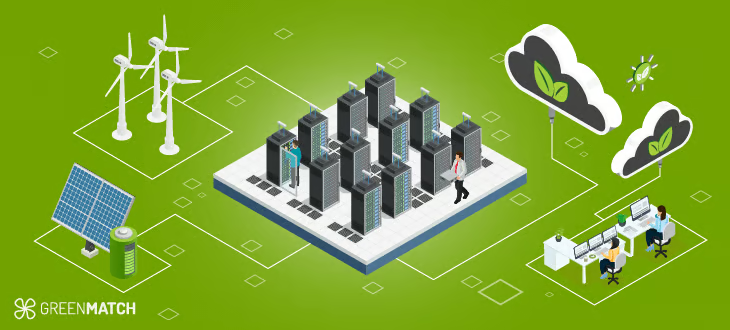
Where a website is hosted has a major impact on its carbon footprint. Data centers vary widely in energy efficiency and energy sources. Green web hosting providers use renewable energy or offset emissions through verified programs.
Some companies operate carbon-neutral or carbon-negative data centers by investing in wind, solar, or hydroelectric power. Others optimize cooling and hardware utilization to minimize waste. Choosing a responsible host can reduce a site’s emissions by more than half without changing a single line of code.
Organizations like World Wide Web Consortium advocate for sustainability as a core web standard, emphasizing that infrastructure decisions are as important as front-end design.
Measuring and Monitoring Website Carbon Impact
You cannot manage what you do not measure. Tools such as Website Carbon Calculator, Lighthouse, and WebPageTest provide insights into page weight, energy usage, and performance. These metrics help teams identify high-impact improvements.
Tracking carbon performance over time ensures that sustainability goals remain part of ongoing development, not a one-off effort. Some organizations now include digital emissions in their annual sustainability reports, reflecting a more holistic view of environmental impact.
Regular audits also prevent regression. New features and content can gradually increase page weight unless sustainability benchmarks are enforced. Measurement turns intention into accountability.
Case Studies: Low-Carbon Websites in Practice
Several high-profile organizations have demonstrated that sustainable web design works at scale. BBC redesigned parts of its digital platforms to prioritize performance, resulting in faster load times and reduced energy consumption for millions of users.
Nonprofits focused on climate action often lead by example, building ultra-lightweight sites that load quickly even on slow connections. These sites prove that compelling storytelling does not require heavy multimedia.
In the commercial sector, ecommerce brands adopting sustainable design principles report improved conversion rates due to faster pages and clearer user journeys. Sustainability becomes a competitive advantage rather than a constraint.

The Future of Sustainable Web Design
As artificial intelligence, video streaming, and immersive technologies expand online, the carbon cost of the web risks increasing further. Sustainable web design will play a critical role in balancing innovation with responsibility.
Regulation and reporting standards are also likely to evolve. Governments and investors increasingly scrutinize digital operations as part of climate commitments. Early adopters of sustainable practices will be better positioned to comply and lead.
Ultimately, the future web must be both powerful and efficient. Sustainable web design is not about limiting creativity. It is about directing creativity toward solutions that respect planetary boundaries while delivering excellent user experiences.
Conclusion: Designing for a Low-Carbon Digital World
Sustainable web design reframes the internet as a physical system with real environmental consequences. By reducing the carbon cost of pages, designers and developers can make a meaningful contribution to climate goals while improving performance and usability.
The most effective approach combines thoughtful design, efficient development, green hosting, and continuous measurement. Small changes at scale create significant impact. For businesses, this is an opportunity to align digital strategy with sustainability commitments and user expectations.
The web will continue to grow. The question is whether it grows responsibly. Sustainable web design offers a clear path forward, one lighter page at a time.
FAQs :
1. What is sustainable web design?
Sustainable web design focuses on creating websites that reduce environmental impact by using less energy, fewer server resources, and more efficient code, while still delivering strong user experiences.
2. How does web design affect the environment?
Websites consume energy through data transfer, hosting servers, and user devices. Heavy images, auto-playing videos, inefficient code, and carbon-intensive hosting all increase a site’s digital carbon footprint.
3. Why is sustainable web design becoming a competitive advantage?
As consumers, investors, and regulators prioritize sustainability, brands with low-impact digital experiences signal responsibility and innovation. Faster, lighter websites also perform better in SEO, conversions, and user retention.
4. Does sustainable web design compromise creativity or branding?
No. Sustainable design encourages clarity, purposeful visuals, and strong storytelling. Many brands find that cleaner layouts and intentional design actually strengthen brand identity.
5. How can companies start adopting sustainable web design?
Organizations can begin by optimizing images, reducing unnecessary scripts, choosing green hosting providers, designing for performance first, and regularly auditing website energy usage.