


Technology is quietly stepping back from screens and stepping closer to us. Wearables, smart glasses, and ambient computing systems are redefining how people interact with digital experiences, often without realizing they are interacting at all. This shift places unprecedented responsibility on user experience design. UX for wearables is no longer about pixels and clicks. It is about presence, context, and restraint.
From fitness trackers that nudge behavior to smart glasses that layer information onto reality, these devices operate at the edge of human attention. According to IDC, global shipments of wearable devices surpassed 530 million units in 2024, signaling mass adoption rather than niche experimentation. Yet adoption alone does not guarantee value. Poor UX in ambient systems feels intrusive, confusing, or exhausting.
This article explores how UX design must evolve for wearables, smart glasses, and ambient computing. It examines core principles, real world examples, and strategic implications for designers and business leaders navigating the post screen era.

What Makes UX for Wearables Fundamentally Different
Designing UX for wearables requires unlearning many assumptions shaped by smartphones and desktops. These devices live on the body or within the environment, not in the hand.
First, attention is fragmented. Users glance, not browse. Research from Google’s Wear OS team shows that most wearable interactions last under five seconds. This means every interaction must deliver value instantly or not exist at all.
Second, input methods are constrained. Tiny screens, voice commands, gestures, eye tracking, and biometric signals replace keyboards and touch heavy interfaces. UX designers must think in terms of intent rather than navigation.
Third, context is everything. Wearables sense location, movement, heart rate, and even stress levels. A well designed experience adapts to whether the user is running, driving, or sitting in a meeting. A poorly designed one interrupts at the worst possible moment.
Consider fitness wearables like the Apple Watch. Its success lies not in feature density but in prioritization. Notifications are filtered, workouts are one tap away, and health data is surfaced when it matters most. This is UX as curation, not presentation.
Smart Glasses UX: Designing for Reality, Not Replacing It
Smart glasses introduce a new challenge: digital information competes directly with the physical world. UX for smart glasses must respect human perception, safety, and social norms.
One of the biggest lessons from early failures like Google Glass is that constant visual overlays overwhelm users. The brain prioritizes real world stimuli. Anything that distracts from vision, especially while walking or driving, becomes a liability.
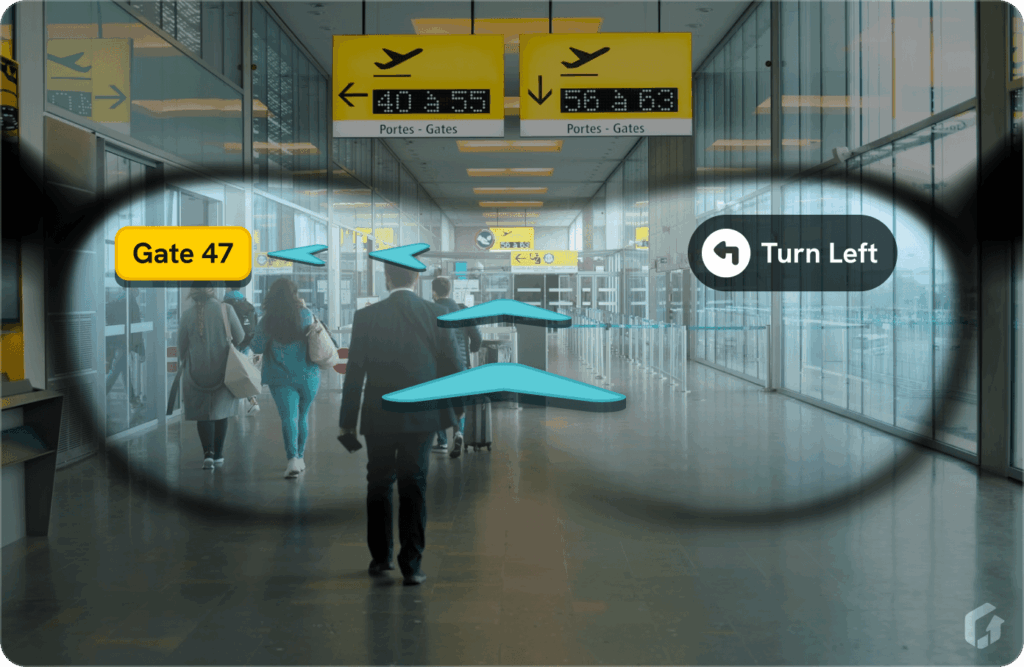
Modern devices like Apple Vision Pro and Meta’s Ray Ban smart glasses take a different approach. Information appears only when summoned. Interfaces are spatial, anchored to the environment rather than floating randomly. Eye tracking and subtle gestures replace menus.
From a UX standpoint, three principles dominate smart glasses design:
- Minimal visual density: Text must be large, contrast high, and elements sparse.
- Spatial relevance: Information should appear where it is useful. Directions near the road, names near faces, controls near objects.
- Social acceptability: UX must consider how users look and behave in public. Obvious gestures or glowing displays discourage use.
A 2023 study by Stanford’s Virtual Human Interaction Lab found that users trusted AR systems more when information appeared intermittently rather than persistently. Less visibility led to more perceived intelligence.
Ambient Computing: UX That Disappears
Ambient computing represents the logical end point of wearable UX. Technology fades into the background and responds automatically to human needs. Smart homes, voice assistants, and sensor driven environments fall into this category.
In ambient systems, UX is not an interface. It is behavior. Lights dim when you relax. Temperature adjusts when you sleep. Notifications wait until you are available.
The challenge here is predictability and trust. When users do not actively control systems, they must understand why something happened. This is where ambient UX often fails.
For example, voice assistants that trigger accidentally erode confidence. Smart thermostats that change settings without explanation feel manipulative. Transparency becomes the new usability metric.
Amazon’s Alexa team has publicly emphasized the importance of explainability. Simple cues like brief audio confirmations or app based activity logs help users feel in control, even when automation is high.
Designers working in ambient computing must answer one core question: How does the system communicate intent without demanding attention?
Designing for the Body, Not the Screen
Wearables sit on wrists, faces, ears, and clothing. UX designers must account for physical comfort, ergonomics, and even fashion.
Haptics play a critical role. A gentle vibration can convey urgency, direction, or completion without visual overload. Studies from MIT Media Lab show that users respond faster to haptic cues than visual alerts in motion based contexts like running or cycling.
Biometric feedback also reshapes UX. Heart rate variability, skin temperature, and sleep cycles allow interfaces to adapt emotionally, not just functionally. A meditation app that suggests breathing exercises during stress moments feels supportive. One that pushes notifications during rest feels invasive.
This bodily integration means UX failures are felt more personally. A bad mobile app is annoying. A bad wearable experience can feel physically uncomfortable or mentally exhausting.
Business Impact: Why UX Is the Competitive Moat
From a business perspective, UX for wearables is not a design afterthought. It is the product.
Hardware differentiation is shrinking. Sensors, batteries, and processors are commoditizing. What separates winners from losers is how seamlessly devices fit into daily life.
According to McKinsey, companies that lead in human centered design outperform industry benchmarks by up to 32 percent in revenue growth. In wearables, this gap is even wider because switching costs are emotional as well as financial.
Consider Whoop, the subscription based fitness wearable. Its UX focuses obsessively on recovery insights rather than raw data. By telling users when to rest, not just when to train, it built a loyal, paying audience despite lacking a screen entirely.
For enterprises, ambient and wearable UX also unlock productivity gains. Smart glasses used in logistics and manufacturing reduce training time and error rates by up to 40 percent, according to PwC. But only when interfaces are intuitive and non intrusive.
Ethical UX in an Always On World
As wearables and ambient systems collect intimate data, UX design carries ethical weight. Consent, privacy, and data visibility must be embedded into the experience, not buried in settings.
Users should always know:
- What data is being collected
- When it is being used
- How to pause or disable it instantly
A single physical gesture or voice command to mute or power down builds trust. Without it, adoption stalls.
The most successful ambient systems give users an escape hatch. Control, even if rarely used, is essential for peace of mind.

Conclusion: Designing Calm Technology for a Noisy World
UX for wearables, smart glasses, and ambient computing is about subtraction, not addition. The goal is not to impress users with features but to support them quietly and intelligently.
Designers must think beyond screens, beyond apps, and beyond moments of use. They must design for bodies, environments, and emotions. Businesses that invest in this level of UX discipline will shape the next decade of human technology interaction.
The future belongs to products that know when to speak and when to stay silent.
FAQs:
1. What is ambient UX in wearables?
It is a low-friction experience that delivers information proactively through subtle cues like haptics, voice, and glanceable displays.
2. How is AR changing wearable UX?
AR moves interaction into physical space, using spatial overlays, gestures, and voice instead of traditional screens.
3. What are the main design challenges?
Small screens, battery limits, privacy concerns, and the need for context-aware interactions.
4. How should notifications be designed?
They must be prioritized, minimal, and context-driven to avoid overload and user fatigue.
5. What role does AI play?
AI enables predictive, personalized experiences based on user behavior and biometrics.