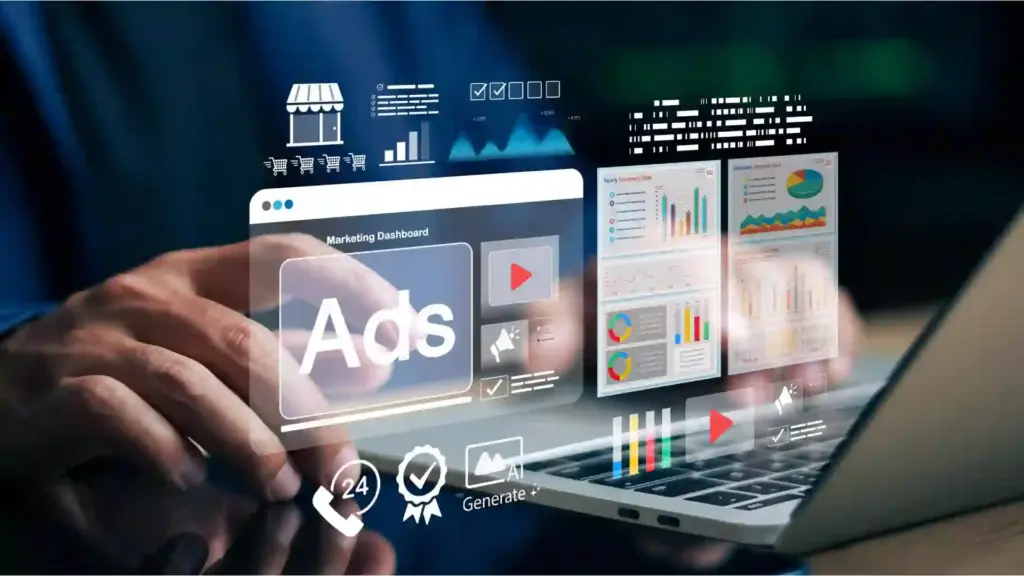


Imagine launching a global marketing campaign without manually writing advertisements, selecting audiences, adjusting budgets, or analyzing daily performance reports. Instead, you tell an artificial intelligence system what your company wants to achieve, approve its operating limits, and watch it coordinate the campaign from beginning to end.
This is the emerging promise of autonomous marketing, a new stage in the evolution of artificial intelligence that could reshape how companies attract customers, build brands, and generate revenue.
By 2027, businesses may increasingly rely on AI agents capable of managing connected marketing activities with limited human intervention. The technology is already advancing rapidly, but one important question remains: Can AI truly run entire campaigns, or will human judgment continue to determine success?
The answer could redefine the future of digital marketing.

What Is Autonomous Marketing, and Why Does 2027 Matter?
Autonomous marketing refers to the use of artificial intelligence systems that can plan, execute, monitor, and optimize marketing activities toward defined business objectives with varying degrees of human supervision.
Traditional marketing automation follows predefined instructions. For example, an email platform sends a welcome message when someone subscribes to a newsletter. Autonomous marketing goes further by evaluating customer behavior, deciding what action to take next, creating relevant content, and adapting its strategy based on results.
The difference is similar to the distinction between cruise control and a self-driving vehicle. One automates a specific function, while the other attempts to coordinate multiple decisions toward a destination.
Three technological developments are driving this transformation.
First, agentic AI is becoming more capable. Unlike conventional chatbots that primarily respond to individual prompts, AI agents can pursue multi-step objectives, use software tools, evaluate results, and initiate subsequent actions.
Second, marketing platforms are integrating more AI-driven decision-making. Advertising systems already use machine learning to optimize bids, identify potential customers, and select creative combinations.
Third, businesses are under increasing pressure to improve marketing productivity. Rising competition, fragmented digital channels, and growing demand for personalized experiences make manual campaign management increasingly difficult.
According to McKinsey & Company’s 2023 research, generative AI could create between $2.6 trillion and $4.4 trillion in annual economic value across industries and business functions. Marketing and sales were identified as major areas of opportunity.
That estimate covers the wider economic potential of generative AI, not autonomous marketing specifically. Nevertheless, it illustrates why companies are investing heavily in intelligent commercial systems.
The significance of 2027 is not that marketing teams will suddenly disappear. Rather, it could represent an important period in which AI evolves from supporting individual marketing tasks to coordinating increasingly complete workflows.
How AI Could Run an Entire Marketing Campaign
To understand the potential of autonomous marketing, consider a hypothetical direct-to-consumer skincare company preparing to launch a product across the United States, Europe, and the Middle East.
Today, that company might need separate specialists for market research, advertising copy, creative design, media buying, email marketing, and performance analysis.
An autonomous marketing system could eventually coordinate much of this work through connected AI agents.
1. Market research and audience discovery
The system could begin by analyzing customer records, product reviews, search trends, competitor positioning, and historical campaign performance.
Instead of relying exclusively on demographic categories, it could identify audience segments based on purchasing behavior, interests, and likely customer needs.
For example, it might discover that customers in one market respond to sustainability messaging while customers elsewhere prioritize product performance or affordability.
However, these findings would still require validation. AI-generated audience insights can reflect incomplete data, misleading correlations, or cultural assumptions.
2. Campaign strategy and creative production
After identifying potential audiences, AI could recommend campaign objectives, channel allocations, creative themes, and performance targets.
Generative AI tools can already produce advertising copy, product descriptions, visual concepts, and video variations. Future systems may combine these capabilities with brand guidelines and performance data to generate coordinated campaigns.
A single product launch could involve dozens of creative variations tailored to different languages, markets, and customer segments.
The challenge would be maintaining brand consistency, cultural sensitivity, and accuracy across every variation.
3. Media buying and budget allocation
AI-driven advertising platforms already automate significant parts of media purchasing.
Google Ads Performance Max uses Google’s AI systems to help advertisers manage campaigns across multiple Google advertising channels. Meta Advantage+ similarly provides automated capabilities for audience targeting, campaign delivery, and creative optimization.
These platforms demonstrate that AI can manage important advertising decisions at scale.
A more advanced autonomous system could coordinate spending across multiple advertising platforms, reallocating budgets according to conversion performance, customer acquisition costs, and expected profitability.
For example, if one advertising channel produced better-quality customers at a lower cost, the system could recommend or execute a budget shift within approved limits.
4. Continuous optimization and reporting
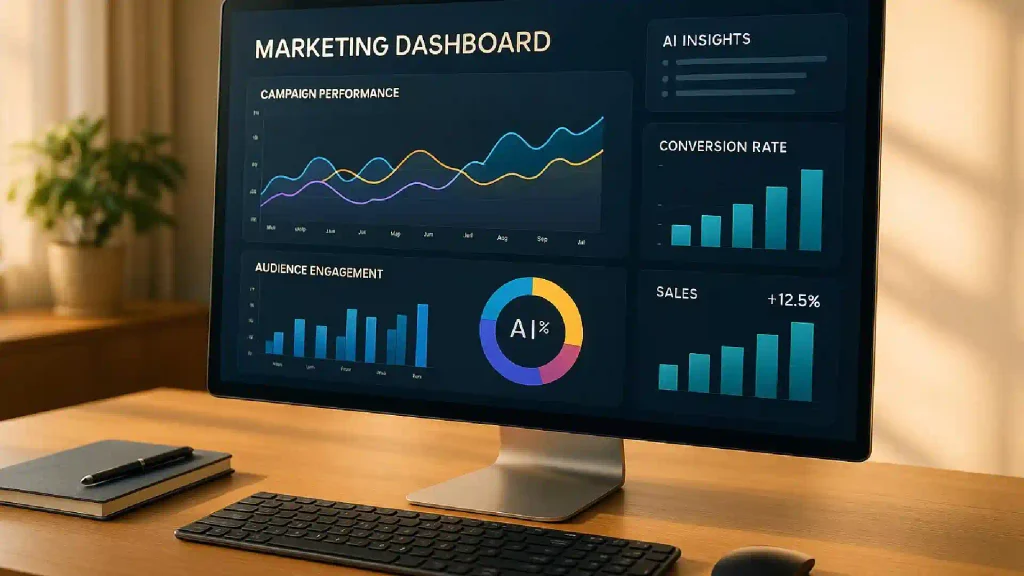
Traditional campaign optimization often involves teams reviewing dashboards and making periodic adjustments.
Autonomous systems could monitor performance continuously, detect declining engagement, test alternative creative assets, and adjust campaign settings.
They could also generate management reports explaining what changed, why it changed, and whether the campaign is progressing toward its objectives.
The result would be a marketing operation that increasingly resembles a continuously learning system rather than a series of disconnected campaigns.
Yet there is a critical distinction: Automating campaign execution is not the same as guaranteeing campaign success.
AI can optimize measurable outcomes, but the quality of those outcomes depends on the objectives, data, constraints, and measurement methods established by humans.
The Business Opportunity: Faster Campaigns, Lower Costs, and Greater Scale
The strongest commercial argument for autonomous marketing is not simply replacing manual work. It is enabling businesses to execute more experiments, respond faster to customers, and make better use of limited resources.
For small and medium-sized enterprises, this could be particularly significant.
A startup with a five-person team may struggle to compete against a multinational company employing hundreds of marketing specialists. AI-powered campaign management could narrow that operational gap by giving smaller organizations access to capabilities previously requiring larger teams.
Consider an online fashion retailer entering three international markets. Rather than hiring separate campaign teams for each country, the retailer could use AI to generate localized advertisements, test customer responses, and monitor spending across regions.
The financial implications are potentially substantial, although actual savings will vary.
McKinsey’s research estimated that generative AI could create productivity value equivalent to 5% to 15% of total marketing spending. This is a modeled opportunity, not a guaranteed reduction in any company’s marketing budget.
These figures reveal a crucial difference between adopting AI tools and building genuinely autonomous marketing operations.
Many companies have AI capabilities, but far fewer have integrated systems that can independently coordinate multiple activities.
The opportunity for 2027 lies in closing that gap.
For entrepreneurs, the competitive advantage may increasingly depend on how effectively they connect customer information, creative production, advertising platforms, and performance measurement into one intelligent workflow.
The Risks: Why Fully Autonomous Marketing Remains Difficult
Despite its potential, autonomous marketing introduces significant business, technical, and ethical risks.
The first challenge is data quality.
AI systems depend on accurate information to make useful decisions. If customer records are incomplete, conversion tracking is unreliable, or sales data is disconnected from advertising platforms, automated optimization can produce misleading results.
An AI agent might increase spending on a campaign generating large numbers of low-quality leads simply because its objective rewards lead volume rather than actual revenue.
The second challenge is brand reputation.
AI-generated content can contain factual errors, inappropriate language, misleading claims, or imagery that conflicts with a company’s identity.
For businesses operating internationally, these risks become more complex. A message that performs well in one culture may be ineffective or offensive in another.
The third challenge is privacy and regulatory compliance.
Marketing systems increasingly operate across jurisdictions with different rules governing personal data, advertising claims, and automated decision-making.
In the European Union, the General Data Protection Regulation establishes important requirements for handling personal information. Companies must ensure that automated personalization and customer profiling comply with applicable laws.
There is also the issue of accountability.
If an autonomous system spends beyond its approved budget, publishes an inaccurate advertisement, or targets an inappropriate audience, who is responsible?
The technology provider, advertising platform, marketing agency, and business owner may each play a role, but responsibility cannot simply be transferred to an algorithm.
This is why human oversight remains essential.
A practical autonomous marketing system should include spending limits, approval requirements, audit logs, compliance checks, and emergency controls.
Without these safeguards, greater automation could simply mean making expensive mistakes faster.
Will AI Replace Marketing Agencies and Human Marketers?
The rise of autonomous marketing raises an uncomfortable question for the advertising industry: What happens when software can perform much of the work traditionally delivered by marketing agencies?
The answer is likely to involve significant changes in how marketing services are created and valued.
Tasks such as producing basic advertising variations, preparing routine reports, adjusting bids, and conducting initial audience analysis are increasingly suitable for automation.
Agencies that rely primarily on these services may face pressure on pricing and margins.
However, marketing involves more than operational execution.
Successful brands require positioning, emotional understanding, creative judgment, cultural awareness, and the ability to identify opportunities that historical data may not reveal.
An algorithm can test hundreds of advertisements, but it cannot independently determine whether a company’s long-term identity should change without relying on human-defined goals and values.
Similarly, AI may identify that a particular message generates more clicks, but marketers must decide whether that message strengthens customer trust.
The future marketing professional may therefore become less of a campaign operator and more of a strategic director.
Marketing teams will increasingly need skills in AI supervision, data interpretation, experimentation, brand governance, and customer experience design.
For agencies, this creates opportunities to move beyond selling production hours toward providing strategy, proprietary expertise, and measurable business outcomes.
Rather than disappearing, the strongest agencies may evolve into smaller, more technology-enabled organizations capable of managing larger client portfolios.

What Autonomous Marketing Could Look Like Across Global Markets
The adoption of autonomous marketing will not be uniform across the world.
In North America, mature advertising platforms and extensive digital commerce infrastructure could accelerate deployment. Businesses with strong customer data systems may be better positioned to integrate autonomous tools into existing operations.
In Europe, privacy requirements and consumer protection obligations will influence how companies design AI-driven marketing systems. Organizations may prioritize transparency, consent management, and tighter control over automated decisions.
In the Middle East, autonomous marketing could create opportunities for companies expanding across multilingual and culturally diverse markets.
Businesses operating in the Gulf Cooperation Council countries often need campaigns that work across Arabic and English, while also respecting local cultural expectations.
AI could help organizations produce and test localized content more efficiently. However, high-quality Arabic communication, cultural interpretation, and brand sensitivity would still benefit from experienced regional professionals.
Across emerging markets in Asia, Africa, and Latin America, autonomous marketing could lower the operational barriers facing smaller digital businesses.
Entrepreneurs who cannot afford large marketing departments may gain access to sophisticated tools for customer segmentation, campaign testing, and international expansion.
Yet access to reliable customer data, payment infrastructure, skilled professionals, and affordable technology will remain important constraints.
The global impact of autonomous marketing will therefore depend not only on AI capabilities, but also on the digital readiness of individual businesses and markets.
How Entrepreneurs Should Prepare for Autonomous Marketing in 2027
Business leaders do not need to wait for fully autonomous systems before capturing value from AI.
The most effective approach is to introduce automation gradually, measure its impact, and expand only when results justify greater independence.
A practical preparation strategy involves five priorities.
1. Build a reliable data foundation. Connect customer relationship management, website analytics, advertising results, and sales information so AI systems can make decisions using consistent data.
2. Start with a controlled pilot. Automate a limited campaign or marketing workflow before expanding into more complex activities. Establish a baseline for cost, conversion rate, and customer quality.
3. Define clear business objectives. Optimize for profitable growth, customer retention, or qualified sales rather than relying exclusively on clicks and impressions.
4. Introduce human approval checkpoints. Require review for sensitive creative content, major budget changes, new audience targeting, and high-risk marketing claims.
5. Train teams to supervise AI systems. Develop employees’ ability to evaluate AI recommendations, investigate unexpected results, and challenge decisions that appear inconsistent with business strategy.
Entrepreneurs should also evaluate technology providers carefully.
An autonomous marketing platform should offer clear reporting, understandable decision histories, data protection controls, and the ability to pause or reverse automated actions.
Companies should avoid assuming that a product described as autonomous can reliably manage every stage of a campaign.
A useful starting point is to ask vendors which decisions the system makes independently, which require approval, and which remain entirely human responsibilities.
These distinctions will matter more than promotional claims about AI capabilities.
The 2027 Outlook: From Marketing Automation to AI-Led Growth
By 2027, autonomous marketing could become a practical operating model for a growing number of digitally mature businesses. However, the transition is more likely to happen in stages than through the sudden arrival of completely independent marketing departments.
The first stage involves AI assisting human marketers with research, content production, and analysis. The second involves connected AI agents coordinating multiple activities under predefined rules. The third, more ambitious stage involves systems independently managing campaigns while escalating important decisions to human supervisors.
The industry is already moving through the first two stages, but broad adoption of the third remains uncertain.
Salesforce’s 2026 research found that marketers using AI agents reported meaningful productivity benefits, while organizations continued to face challenges involving data integration, privacy, and accuracy. Salesforce+1
These findings suggest that the biggest barrier to autonomous marketing may not be the ability to generate advertisements or adjust budgets. It may be the difficulty of building systems that businesses can consistently trust.
The companies that succeed will likely combine AI efficiency with strong human leadership, reliable data, and disciplined measurement.
Conclusion: Can AI Really Run Entire Marketing Campaigns?
Yes, AI can already automate substantial parts of marketing campaigns, and by 2027 it could manage increasingly complete campaign workflows. But fully independent marketing remains a more difficult proposition.
AI is becoming capable of coordinating audience research, creative production, media buying, customer engagement, and performance optimization. These developments could reduce operational costs, accelerate experimentation, and allow smaller companies to compete more effectively.
However, technology alone cannot guarantee strong branding, customer trust, cultural relevance, or sustainable business growth.
For entrepreneurs, the most important question is not whether AI will replace marketing teams. It is how businesses can redesign marketing operations to benefit from intelligent automation without sacrificing accountability.
The future of marketing may belong neither entirely to humans nor entirely to machines.
It may belong to businesses that know how to make both work together.
FAQs:
1. What is autonomous marketing?
Autonomous marketing uses artificial intelligence to plan, execute, monitor, and optimize marketing activities with limited human intervention. It combines AI agents, marketing automation, predictive analytics, and connected advertising platforms.
2. Can AI run an entire marketing campaign in 2027?
AI could manage most operational stages of certain campaigns by 2027, including content creation, targeting, budget adjustments, and reporting. However, human supervision will remain important for strategy, compliance, brand reputation, and major financial decisions.
3. Will autonomous marketing replace digital marketing agencies?
Autonomous marketing may reduce demand for routine campaign management and content production. Agencies offering strategic planning, original creative ideas, industry expertise, and AI governance may remain highly valuable.
4. What are the biggest benefits of autonomous marketing for small businesses?
Potential benefits include faster campaign launches, lower production costs, more personalized communication, continuous optimization, and the ability to operate across multiple markets without significantly expanding staff.
5. What are the main risks of AI-driven marketing campaigns?
The main risks include inaccurate customer data, misleading AI-generated content, privacy violations, uncontrolled advertising spending, algorithmic bias, and poor brand decisions. Clear safeguards and human oversight can help reduce these risks.