


Every founder eventually faces the same question: should we focus on frontend or backend development first? The decision sounds technical, but its impact is deeply strategic. Frontend vs backend development is not just about code. It shapes user experience, scalability, hiring costs, and even investor confidence.
Think of your product like a restaurant. The frontend is the dining area, menu, and service style that customers see and feel. The backend is the kitchen, supply chain, and recipes that make the experience possible. Both matter, but depending on your stage, one usually deserves priority.
This guide is written for founders, not engineers. It breaks down frontend vs backend development in plain language, explains when each matters most, and helps you decide where to invest first. Whether you are building an MVP or scaling globally, the choices you make here will compound over time.
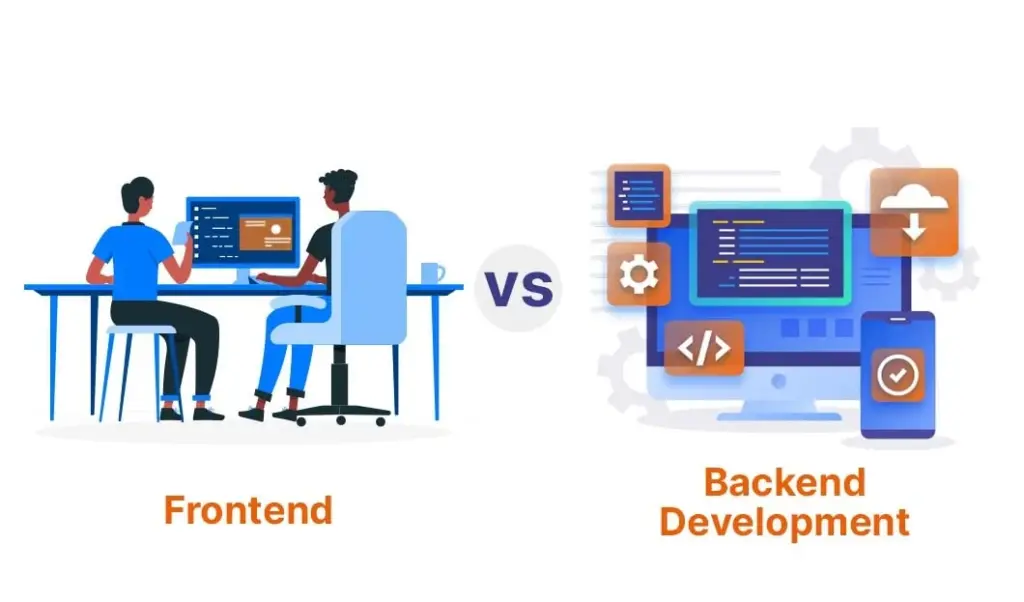
What Is Frontend Development and Why Founders Should Care
Frontend development refers to everything users see and interact with in a digital product. This includes layout, design, navigation, buttons, animations, and responsiveness across devices.
From a founder’s perspective, frontend development directly influences perception. Research by Google shows users form an opinion about a website in under 50 milliseconds. That first impression often determines whether they stay, sign up, or leave.
Core responsibilities of frontend development
Frontend developers translate product ideas and designs into interactive experiences. Their work typically includes:
- Building user interfaces with HTML, CSS, and JavaScript
- Ensuring mobile and cross browser compatibility
- Improving page speed and visual performance
- Collaborating closely with designers and product managers
A strong frontend can compensate for early product gaps. Many successful startups launched with limited features but exceptional usability. Early versions of Airbnb focused heavily on clean design and trust signals, even while backend systems were still evolving.
When frontend should be your priority
For founders, frontend development should come first when:
- You are validating an idea or building an MVP
- User experience is your main differentiator
- Your product depends on adoption and engagement
- You are pitching to investors or early customers
In practical terms, a polished frontend helps you test demand faster. It is easier to change layouts, flows, and copy than to rearchitect backend systems. This flexibility is critical in the early stages.

What Is Backend Development and Why It Powers Scale
Backend development is the invisible engine of your product. It handles data, logic, security, and integrations. Users may never see it, but they feel its effects when things break or slow down.
If frontend is the storefront, backend is the warehouse, accounting system, and logistics network combined. Without it, nothing works reliably.
Core responsibilities of backend development
Backend developers focus on:
- Managing databases and data models
- Handling user authentication and permissions
- Building APIs that connect frontend and services
- Ensuring performance, reliability, and security
- Integrating payment systems, analytics, and third party tools
According to IBM’s Cost of a Data Breach Report, the average breach costs companies over $4 million globally. Weak backend architecture and security practices are often the root cause. For founders, this is not just a technical risk but a business one.
When backend should be your priority
Backend development becomes critical when:
- You handle sensitive user or financial data
- Your product depends on complex logic or workflows
- You are scaling users, transactions, or geographies
- Reliability and uptime affect revenue directly
For example, fintech, health tech, and SaaS platforms must prioritize backend early. A beautiful interface means little if transactions fail or data is inconsistent.
Frontend vs Backend Development: A Side by Side Comparison
To make founder decisions easier, here is a practical comparison of frontend vs backend development.
Business impact
Frontend development drives:
- User acquisition
- Engagement and retention
- Brand perception
Backend development drives:
- Scalability and stability
- Data integrity
- Monetization and automation
Cost considerations
Frontend development often has:
- Faster initial build times
- Lower early costs for MVPs
- Higher iteration frequency
Backend development often has:
- Higher upfront architectural costs
- Longer development cycles
- Greater long term savings if done right
A 2024 survey by Stack Overflow showed backend developers command slightly higher median salaries globally, reflecting the complexity and risk associated with backend systems. Founders should factor this into hiring plans.
Risk profile
Frontend risks are usually visible and fixable quickly. Backend risks are hidden but can be catastrophic when they surface. A poor backend decision can require months of refactoring, while frontend changes are often measured in days.

Do You Really Need Full Stack Developers
Many founders ask if they should just hire full stack developers to cover both frontend and backend. The answer depends on stage and ambition.
The case for full stack early on
In early stage startups, full stack developers offer:
- Speed and flexibility
- Lower headcount costs
- Better cross functional understanding
For MVPs and small teams, this can be a smart choice. One capable full stack developer can build, test, and iterate quickly without heavy coordination overhead.
The limits of full stack at scale
As your product grows, depth matters more than breadth. Complex systems demand specialists. Frontend performance optimization and backend scalability are both deep disciplines.
Many scaling startups transition from generalists to specialists after product market fit. This evolution is normal and healthy.
How Founders Should Decide What to Build First
There is no universal answer in frontend vs backend development. Instead, founders should ask the right questions.
Ask these four questions
- What is the biggest risk to my business right now?
- What must work flawlessly on day one?
- What can I change cheaply later?
- Where do users derive immediate value?
If user trust and data integrity are core, invest in backend first. If adoption and differentiation matter most, prioritize frontend.
A practical rule of thumb
- Pre MVP: 60 percent frontend, 40 percent backend
- Post MVP with traction: 50 percent frontend, 50 percent backend
- Scaling phase: 40 percent frontend, 60 percent backend
These ratios are not rigid, but they help founders allocate time, budget, and talent more deliberately.
Real World Founder Scenarios
Consider two hypothetical startups.
A consumer marketplace founder focused heavily on backend automation before validating demand. The result was a robust system with no users. A competitor launched later with a simple backend but superior frontend and won early market share.
In contrast, a B2B SaaS founder rushed frontend polish while neglecting backend scalability. When a large enterprise client signed on, performance issues caused churn and damaged credibility.
Both cases highlight the same lesson. Frontend vs backend development decisions should align with business stage, not personal preference or hype.
Conclusion: Think Balance, Not Opposition
Frontend vs backend development is not a rivalry. It is a partnership. The best products succeed because both sides reinforce each other.
For founders, the real skill lies in sequencing. Build just enough backend to support your vision. Build just enough frontend to prove demand. Then invest deeply where the business model requires it.
As technology stacks evolve and no code tools mature, the distinction may blur. But the underlying principles will remain. Users care about experience. Businesses depend on reliability. Founders must respect both.
The smartest teams treat frontend and backend as strategic assets, not technical chores. That mindset is what separates products that look good from companies that last.
FAQs:
1. What is the difference between frontend and backend development?
Frontend development focuses on what users see and interact with, such as design, layout, and user interface. Backend development handles servers, databases, and application logic behind the scenes.
2. Which is more important for early stage startups?
Both matter, but frontend often drives first impressions and conversions, while backend ensures stability and scalability. Founders should prioritize based on product type and growth goals.
3. Can one developer handle both frontend and backend?
Yes. Full stack developers manage both areas, which can reduce costs in early stages. As the product grows, specialization becomes more efficient.
4. How does this decision affect scalability?
A strong backend architecture supports growth, traffic spikes, and integrations. A well built frontend improves engagement and customer retention.
5. Is backend development more expensive than frontend?
Backend development can require more complex infrastructure and security layers, which may increase costs. However, project scope determines overall investment.
6. How do founders decide where to invest first?
If user acquisition and branding are priorities, invest in frontend. If performance, data processing, or system reliability are critical, prioritize backend.