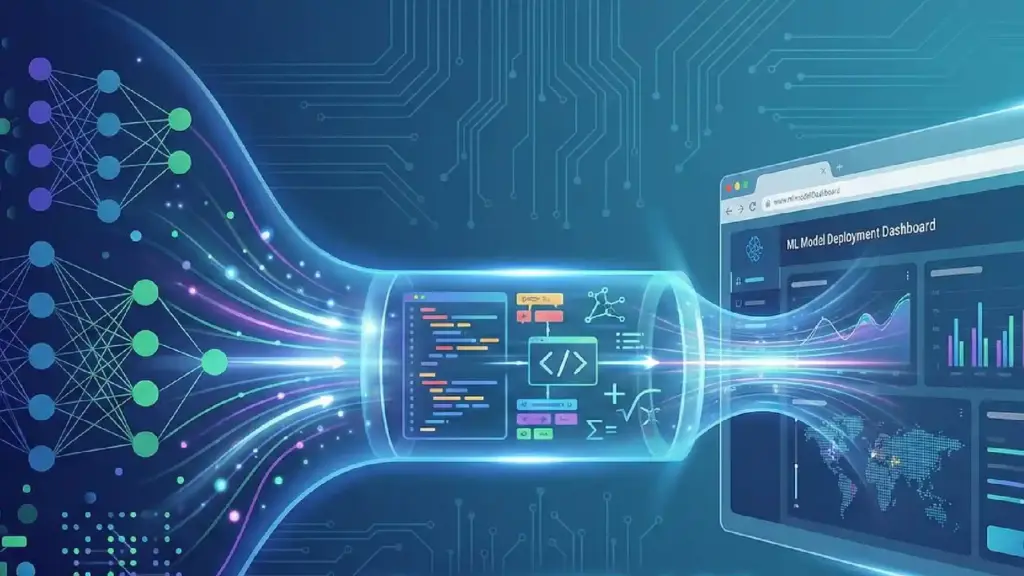


Artificial intelligence is changing the way websites are built, and it is doing so faster than many developers expected. Tasks that once required hours of coding can now be completed in minutes using AI-powered tools. From generating entire website layouts to fixing programming errors, AI is becoming a powerful force in the technology industry.
This rapid progress raises an important question: Can AI replace web developers completely?
For businesses, AI promises faster development and lower costs. For developers, it creates both opportunities and uncertainty about job security. Yet building a successful website involves much more than writing code.
The future of web development is unlikely to be a simple competition between humans and machines. Instead, it will depend on how effectively developers combine technical expertise, creativity, and artificial intelligence.

Can AI Replace Web Developers Completely?
The short answer is no, not completely. AI can automate many web development tasks, but it cannot reliably replace every responsibility of a professional developer.
Modern AI tools can generate HTML, CSS, JavaScript, and even complex application components from natural-language instructions. A business owner can describe a website idea and receive a working prototype without writing a single line of code.
However, creating a website is only one part of the development process.
Professional web developers also need to understand customer requirements, design secure systems, integrate databases, optimize performance, and ensure that applications work reliably for real users.
AI-generated code can contain security weaknesses, performance problems, and unexpected errors. These issues become particularly important when websites handle payments, customer information, or sensitive business operations.
For example, an AI website builder may produce an attractive online store in minutes. But connecting inventory systems, securing transactions, managing customer accounts, and maintaining the platform as the business grows require deeper technical decisions.
This distinction explains why AI is more likely to replace individual development tasks than the entire web developer profession.
The important difference is accountability. AI can suggest a solution, but a developer or engineering team must determine whether that solution is correct, secure, maintainable, and suitable for the business.
How AI Is Transforming Web Development
The impact of AI on web development is already visible across startups, technology companies, and digital agencies.
AI is no longer limited to autocomplete suggestions. Modern systems can examine project files, generate code across multiple components, propose changes, and assist with testing.
Consider an entrepreneur launching an online booking service. Previously, building a prototype might require several weeks of coordination between designers and developers. AI tools can now help create an initial interface much faster.
The entrepreneur still needs to validate the business model, connect payment systems, manage booking availability, and protect customer data. But the cost of testing an idea can fall significantly.
This shift matters especially in emerging entrepreneurial markets, where early-stage businesses often have limited technical budgets.
The wider implication is that developers may spend less time producing basic code and more time solving meaningful business problems.
Will AI Take Web Developer Jobs?
AI is likely to change the composition of web development employment, but predictions of the profession’s complete disappearance are not supported by current labor-market forecasts.
The U.S. Bureau of Labor Statistics projected 7% employment growth for web developers and digital designers between 2024 and 2034, faster than the average across occupations.
That projection does not guarantee opportunities for every developer or in every country. It does, however, challenge the assumption that AI adoption automatically means the end of web development careers.
The World Economic Forum’s Future of Jobs Report 2025 also identifies software and application developers among the fastest-growing job roles through 2030.
At the same time, the report expects significant disruption to existing skills across the global workforce.
The two trends can exist together. Companies may need more digital products while requiring fewer hours of manual coding to produce each one.
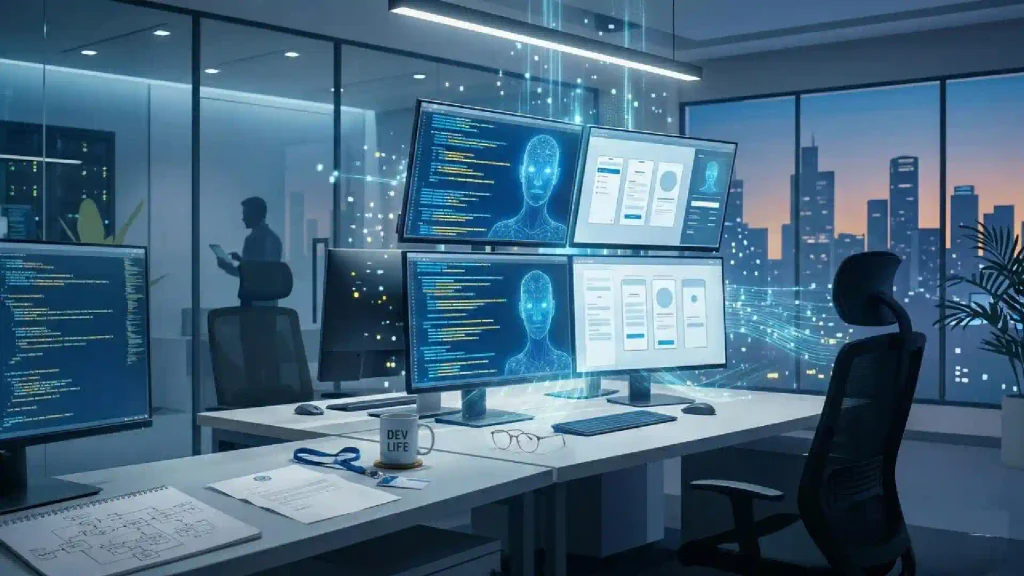
Which web development jobs face the greatest risk?
Routine, predictable tasks are particularly exposed to automation.
Developers whose work consists mainly of converting simple designs into basic pages, producing repetitive components, or maintaining uncomplicated templates may face stronger competition from AI tools and lower-cost development services.
Entry-level positions could also change as companies automate some of the tasks traditionally assigned to junior developers.
However, this does not mean that every junior position will disappear. Organizations still need people who can learn their systems, investigate problems, test software, and grow into experienced engineers.
Developers working on complex applications, cybersecurity, cloud infrastructure, accessibility, and system architecture may be better positioned because their work requires broader judgment.
The biggest employment risk may not be AI replacing all developers. It may be developers who use AI effectively becoming more competitive than those who do not.
The updated U.S. forecast covers 2025 to 2035 and projects 5% growth for the combined occupation. This is a more recent estimate than the earlier 7% projection for 2024 to 2034. Bureau of Labor Statistics+1
Why Human Web Developers Still Matter
AI can generate impressive code, but writing code and building dependable software are not the same thing.
A website may look professional while hiding serious problems beneath its design. It could expose private customer information, fail under heavy traffic, or provide a frustrating experience for people using assistive technologies.
Experienced developers identify these risks and make decisions that extend beyond individual programming instructions.
The 2025 Stack Overflow Developer Survey found that 46% of respondents distrusted the accuracy of AI-generated output, compared with 33% who trusted it. This highlights an important limitation: the ability to generate an answer does not guarantee that the answer is correct. 2025 Stack Overflow Developer Survey
The following capabilities remain particularly important.
Problem-solving and business understanding. A developer must translate a company’s goals into a useful digital product. That involves asking questions, identifying constraints, and choosing between competing solutions.
Security and reliability. AI can suggest authentication systems and security controls, but those systems still require careful testing, review, and ongoing monitoring.
Creativity and user experience. AI can produce attractive interfaces, but understanding why customers abandon a checkout process or struggle with a navigation system requires research and interpretation.
Long-term maintenance. Websites evolve alongside the organizations they serve. Developers must manage technical debt, update systems, and ensure that new features do not break existing ones.
These responsibilities explain why professional judgment remains valuable even as coding becomes increasingly automated.
The Future of Web Development: What to Expect by 2030
The next phase of web development will likely involve closer collaboration between developers and increasingly capable AI agents.
Instead of writing every component manually, developers may supervise AI systems that generate code, execute tests, review changes, and prepare applications for deployment.
This could make smaller engineering teams more productive, although the size of those gains will depend on the complexity of the project.
An earlier controlled experiment published by GitHub found that developers using Copilot completed a specific JavaScript programming task 55% faster than participants working without it. The experiment involved 95 professional developers, so the result should not be interpreted as a universal productivity increase across all software projects.
AI-first development workflows
AI assistants will increasingly become part of everyday development environments rather than separate tools.
Developers will move between writing instructions, reviewing generated code, running tests, and correcting problems. Understanding how to direct AI systems will become a practical professional skill.
Greater demand for specialized expertise
As basic website creation becomes more accessible, complex technical expertise may become a stronger competitive advantage.
Businesses will still need developers who understand secure financial applications, healthcare platforms, enterprise integrations, cloud services, and large-scale commerce.
These projects involve legal obligations, operational risks, and technical requirements that cannot be solved through visual design alone.
New opportunities for entrepreneurs
AI-powered development could lower the cost of launching digital businesses.
A founder in India, the UAE, Kenya, or Brazil may be able to build and test an early product with fewer resources than would previously have been required.
However, cheaper prototypes may also increase competition. When more entrepreneurs can build software, the advantage shifts toward customer understanding, distribution, service quality, and execution.
For founders, AI reduces some technical barriers but does not remove the need for a viable business model.

How Web Developers Can Future-Proof Their Careers
The strongest response to AI is not to avoid it. Developers should learn how to use it while strengthening the skills that make their judgment valuable.
The World Economic Forum estimates that 39% of workers’ existing skills will change or become outdated between 2025 and 2030. Continuous learning is therefore becoming a central requirement across the labor market, not just in software development. World Economic Forum
For developers, a practical career strategy includes:
1. Master programming fundamentals. Learn HTML, CSS, JavaScript, databases, APIs, and how browsers work. These foundations make it easier to identify incorrect AI-generated code.
2. Become proficient with AI coding tools. Use assistants for prototypes, debugging, testing, and documentation while reviewing their outputs carefully.
3. Develop full-stack capabilities. Understanding both front-end interfaces and back-end systems makes developers more adaptable.
4. Learn cybersecurity and cloud fundamentals. Secure authentication, data protection, infrastructure, and performance optimization remain essential business needs.
5. Build communication and product skills. Developers who understand customers, collaborate with teams, and explain technical trade-offs can contribute beyond writing code.
For beginners, learning web development remains worthwhile. However, memorizing syntax alone is unlikely to provide a lasting competitive advantage.
A stronger approach is to build real projects, understand the reasoning behind technical decisions, and use AI as a learning and productivity partner.
What AI Means for Businesses Hiring Web Developers
For business owners, AI creates an opportunity to reconsider how digital projects are planned and delivered.
A small business that needs a simple landing page may find that an AI-assisted website builder meets its requirements. Hiring a full development team for such a project may no longer be necessary.
However, an organization developing a custom marketplace, financial platform, or business-critical application should evaluate its needs more carefully.
The cheapest way to generate a website is not necessarily the cheapest way to operate it over several years.
Security incidents, performance failures, poor integrations, and expensive maintenance can quickly outweigh initial development savings.
Businesses should therefore assess AI development tools using measurable outcomes: delivery time, defect rates, maintenance costs, customer experience, and security performance.
The most effective strategy will often combine AI automation with experienced technical oversight.
This approach allows companies to benefit from faster development without transferring every important decision to an automated system.
Conclusion: AI Will Change Web Development, Not Simply End It
So, can AI replace web developers?
AI can already replace substantial portions of routine website production, and its capabilities are continuing to improve. But there is still a meaningful difference between generating code and delivering a secure, reliable, commercially successful digital product.
The profession will evolve as AI becomes more capable. Some tasks and roles may shrink, while new responsibilities emerge around architecture, integration, quality assurance, and AI-assisted engineering.
For developers, the priority is to combine strong technical foundations with AI fluency and business understanding. For entrepreneurs, the opportunity is to use AI to build faster while maintaining human accountability for important decisions.
The future does not belong exclusively to AI or to traditional developers. It belongs to people and organizations that can use both effectively.
FAQs:
1. Can AI completely replace web developers?
Not reliably across the full profession. AI can generate code and automate many development tasks, but complex projects still require human oversight, security expertise, and business judgment.
2. Will web developers still be needed in 2030?
Current forecasts suggest continued demand. The World Economic Forum identifies software and application developers among the fastest-growing job categories through 2030, although individual roles will evolve.
3. Is learning web development worth it in the age of AI?
Yes. Programming fundamentals, system design, cybersecurity, and practical problem-solving remain valuable. Learning to work with AI tools can improve career adaptability.
4. Which web development tasks can AI automate?
AI can help generate layouts, write routine code, create tests, explain errors, produce documentation, and build prototypes. Its outputs still need validation.
5. Will AI reduce web developer salaries?
AI could put downward pressure on prices for routine development services while increasing demand for some specialized skills. The overall impact on salaries remains uncertain and will differ by market, experience, and expertise.