


For the past three years, adding artificial intelligence to a website usually meant adding a chat window.
A small icon appeared in the bottom-right corner. Visitors clicked it, typed a question and received an AI-generated response. For many companies, this became the definition of an “AI-powered website.”
That definition is already becoming outdated.
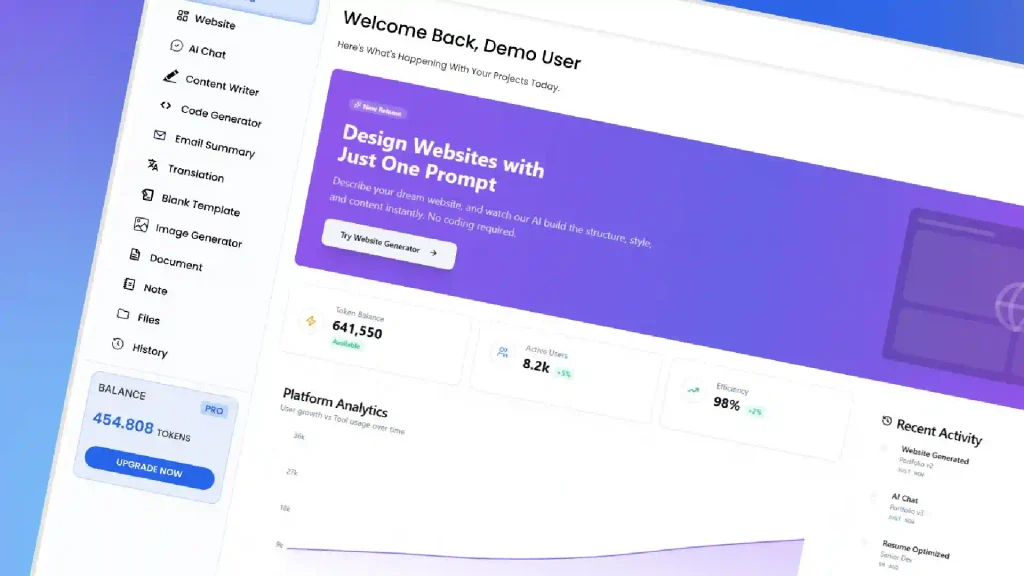
The next generation of AI-native websites will not simply place an assistant on top of an existing interface. AI will increasingly determine what information appears, which interface is generated, which tools are activated and, with permission, which actions happen next.
The distinction is significant. A chatbot waits for questions. An AI-native website understands intent and reorganizes the digital experience around the task.
The web is beginning to shift from pages people navigate toward systems people instruct.
The Chatbot Was Only the First Interface
Chatbots were a logical starting point for generative AI because conversation is universal. Users do not need to learn a new menu structure. They can simply describe what they want.
But conversation has limitations.
Imagine visiting an airline website and typing: “Find me the best business-class option from Doha to Singapore next Thursday, arriving before 5 p.m., and compare refundable fares.”
A chatbot could respond with paragraphs describing several flights. That is useful, but it is hardly the ideal interface. A better system would understand the request and instantly generate a comparison containing departure times, prices, refund conditions and relevant booking controls.
The interface itself becomes part of the answer.
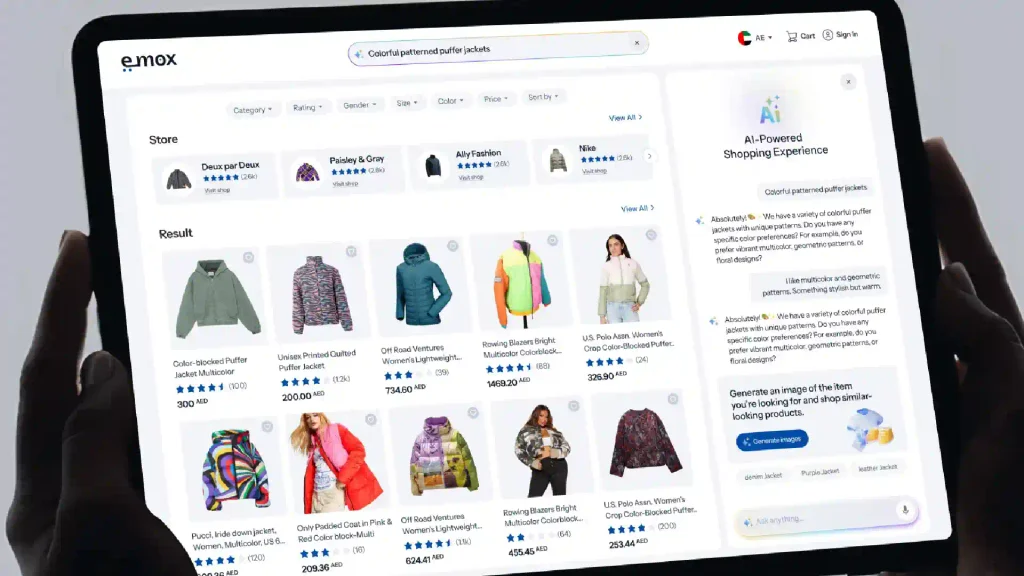
This idea is known as generative UI. Instead of forcing every request through a predetermined collection of pages and menus, software can assemble interface components appropriate to a user’s objective.
The technical infrastructure is already moving in this direction. Vercel’s AI SDK, for example, has developed from tools for conversational applications into infrastructure supporting agents, tool execution and richer AI experiences. Vercel previously demonstrated generative UI that lets language models return interactive components rather than only text.
The implication for web design is substantial: the website of tomorrow may have fewer fixed journeys.
It may have millions of potential journeys assembled dynamically.
From Websites That Answer to Websites That Act
The more consequential change is not conversational interfaces. It is agentic AI.
Traditional websites require humans to perform almost every step. Search. Filter. Compare. Open another page. Fill in a form. Confirm the details. Repeat.
AI agents reverse part of that relationship. Instead of operating every control yourself, you give software an objective and allow it to perform parts of the workflow.
We can already see this model emerging in search. In May 2026, Google described new AI capabilities in Search that include information agents operating in the background and expanded agentic booking capabilities. Google also said AI Mode had surpassed one billion monthly users, with queries more than doubling every quarter since launch.
That scale matters because it suggests consumers are becoming accustomed to expressing goals rather than navigating rigid information structures.
Consider how this changes an e-commerce website.
The old experience begins with categories:
Men → Shoes → Running → Size → Brand → Price.
An AI-native experience could begin with:
“I need comfortable running shoes for a half-marathon in humid weather. I overpronate slightly and want to spend less than $180.”
The website can interpret the constraints, query inventory, compare suitable products and create an interface specifically for that buying decision.
Eventually, with appropriate safeguards and authorization, the user might simply say:
“Buy the pair I usually prefer if the price drops below $140.”
At that point, the website is no longer primarily an information destination. It becomes an executable service.
The Website May Soon Have Two Audiences: Humans and Agents
There is another transformation happening quietly beneath the interface.
Websites have historically been designed for humans and crawlers. Humans see pages; search engines crawl structured information and links.
AI introduces a third participant: agents that need to understand and operate digital services.
An agent trying to change a reservation does not necessarily need an attractive account dashboard. It needs reliable access to the relevant capability: retrieve reservation, identify available alternatives, calculate any price difference and submit an approved change.
Emerging standards illustrate where this architecture could lead.
Anthropic introduced the Model Context Protocol (MCP) in 2024 as an open standard for connecting AI systems with external tools and data. By December 2025, Anthropic reported more than 10,000 active public MCP servers and said MCP had been adopted across products including ChatGPT, Gemini, Microsoft Copilot and Visual Studio Code. MCP was subsequently donated to the Agentic AI Foundation under the Linux Foundation.
A related development is happening directly on the web. OpenAI currently describes WebMCP as a proposed web standard through which websites can make tools available directly to AI agents. Its site-tools implementation allows supported websites to expose functions that an AI can use to search information, modify content, explore dashboards or update a shopping cart.
This suggests an important architectural shift.
Companies may increasingly need to design both a human interface and an agent interface.
The first needs clarity, aesthetics and usability. The second needs structured data, well-defined permissions and predictable tools.
In that world, “Is our website mobile-friendly?” gains a new companion question:
“Is our business agent-friendly?”
AI-Native Websites Will Be Personal, but Not Simply Personalized
Personalization itself is hardly new. E-commerce platforms have recommended products for decades, while streaming services routinely reorder content based on viewing behavior.
AI-native personalization is potentially much deeper.
A traditional personalized website essentially says: “People similar to you often want this.”
An AI-native website can potentially ask: “What are you trying to accomplish right now?”
Those are fundamentally different questions.
Imagine two entrepreneurs visiting the same bank website. One runs a two-person consulting business in Dubai. The other operates a manufacturing company with 400 employees across Southeast Asia.
Today, both may encounter essentially the same navigation.
An adaptive website could instead construct experiences around their respective contexts. The consultant might see business accounts, invoicing and international payment options. The manufacturer might receive treasury-management tools, trade-finance information and foreign-exchange scenarios.
Even the presentation could change.
Someone researching may receive an explanatory interface. Someone ready to purchase may receive comparison and transaction tools. A returning customer with an unresolved support case might immediately receive the status of that case.
The website stops asking every visitor to understand the company’s organizational structure.
Instead, the software attempts to understand the visitor’s objective.
That is a profound inversion of conventional web design.
Search Is Changing What a Website Is For
There is also a strategic problem businesses cannot ignore: people increasingly encounter information through AI systems before visiting the original website.
Google said in an August 2026 update that AI Overviews had more than 2.5 billion monthly active users, while AI Mode had exceeded one billion.
This changes the economics of digital discovery.
For two decades, the standard web funnel was relatively straightforward:
Search → website → browse → convert.
The emerging journey can look more like:
Ask AI → AI researches multiple sources → AI recommends options → user visits only when necessary.
And sometimes even that final visit may shrink.
Google is already adding agentic capabilities for tasks such as finding reservations and services, while AI systems are becoming capable of navigating websites and interacting with forms.
Businesses therefore face two simultaneous challenges.
They must make their websites exceptionally valuable when humans arrive, while making their information and services understandable to machines when humans do not.
That could eventually make AI visibility as important as traditional SEO.
The objective will not simply be ranking a webpage. Companies will need authoritative, structured, current information that AI systems can confidently retrieve and interpret.
For entrepreneurs, this creates opportunities for an entirely new layer of optimization, analytics and infrastructure.
Trust Becomes Part of the Interface
There is, however, a major difference between an AI recommending an article and an AI spending money.
The more websites can act, the more important trust architecture becomes.
If an agent is changing a flight, purchasing inventory or sending information to another company, users need to understand what the system is doing and where authorization begins and ends.
That means AI-native design will require more than better models.
It will require permission systems, confirmation mechanisms, audit histories, identity controls and clear boundaries around sensitive actions.
Current agent systems already demonstrate this principle. OpenAI’s site-tools documentation says sensitive activities such as purchases, deleting information, changing permissions or sending messages require user confirmation. It also highlights risks including prompt injection and unauthorized data sharing.
For businesses, this makes trust a product-design problem rather than merely a legal disclaimer.
The winning experience may not be the AI that performs the most actions automatically. It may be the system that makes users comfortable delegating the right actions.
A financial platform, for example, could distinguish between:
“Show me my cash-flow forecast.”
“Prepare payments for these invoices.”
“Send the payments.”
Those represent three different levels of authority: analysis, preparation and execution.
Good AI-native products will make those boundaries obvious.
What Entrepreneurs Should Build Now
The temptation is to interpret AI-native websites as another redesign cycle. Replace the navigation bar with a prompt box, connect an LLM and call the product intelligent.
That misses the larger opportunity.
Entrepreneurs should think in terms of capabilities rather than pages.
Start by identifying the five or ten outcomes customers most frequently want from your website. For a hotel, those could include finding a room, comparing rates, changing a booking, requesting an upgrade and arranging airport transportation.
Then ask whether AI could shorten each journey.
The most useful progression is likely to be:
- Answer: Help users understand information.
- Recommend: Interpret context and present relevant options.
- Generate: Build the right interface for the task.
- Act: Execute approved steps through tools and APIs.
- Anticipate: With permission, monitor conditions and initiate useful workflows.
Not every business needs the fifth stage.
In fact, many excellent AI-native products may deliberately stop earlier because regulation, risk or customer preference requires human control.
But the strategic question has changed.
Businesses once asked, “How do we add AI to our website?”
A better question for 2026 is:
“If we were building this company for AI-first customers and AI agents today, would we design a website this way at all?”

The Post-Chatbot Web
The chatbot is unlikely to disappear. Conversation remains one of the simplest ways humans can express complicated intentions.
But the chat window may become only the command layer.
Behind it will sit systems capable of retrieving information, reasoning across data, calling tools, generating interfaces and completing carefully authorized actions. In front of it may appear dashboards, comparisons, maps, forms, simulations or entirely new interfaces generated for a single request.
The result is not a website with AI added.
It is software that continuously decides how best to serve a user’s objective.
For entrepreneurs, the opportunity extends far beyond customer support. AI-native websites could reshape commerce, travel, finance, education, healthcare, media and enterprise software.
The web’s first era was about publishing information. Its second was about interactive applications. The mobile era made those services ubiquitous.
The AI-native era could be about something different again: delegation.
We will still visit websites.
Increasingly, however, we may arrive not to browse them, but to tell them what we want done.
FAQs:
What is an AI-native website?
An AI-native website is a digital experience designed around artificial intelligence from the beginning rather than adding AI as a standalone chatbot. It can understand user intent, retrieve relevant data, generate interfaces and potentially perform authorized actions.
How is an AI-native website different from a chatbot?
A chatbot primarily communicates through conversation. An AI-native website can use conversation as one input while also generating visual interfaces, accessing tools, adapting content and completing workflows.
What is generative UI?
Generative UI is an approach in which AI dynamically creates or selects interface components based on a user’s request. Instead of responding only with text, the system might produce a comparison table, calculator, dashboard, form or other interactive experience.
Will AI agents replace websites?
Websites are unlikely to disappear, but their role may change. Human-facing interfaces will remain important while businesses increasingly expose structured information and capabilities that authorized AI agents can interact with.
How should businesses prepare for AI-native websites?
Businesses should identify their customers’ most important outcomes, improve structured data and APIs, experiment with adaptive interfaces and AI agents, and establish strong permission and confirmation systems. The objective should be reducing the distance between customer intent and a trustworthy result.